-1.png?width=400&height=164&name=DWRLogoClassic%20-%20Copy%20(2)-1.png)


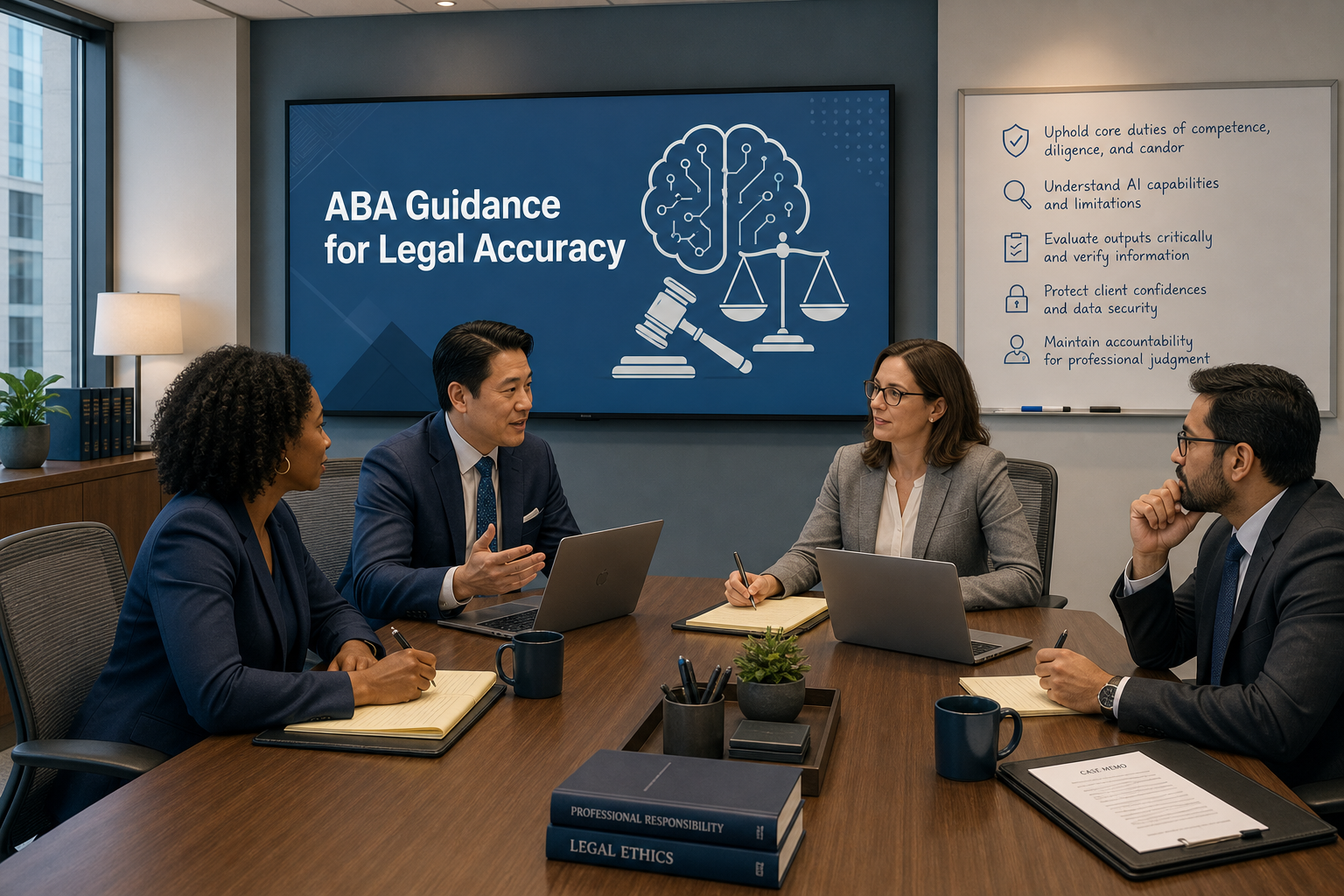
ABA Opinion 512: The Duty of Competence includes knowing when AI output is inaccurate. As artificial intelligence transforms eDiscovery workflows, legal professionals must ensure AI-assisted review meets ethical obligations and produces defensible results that withstand judicial scrutiny.
Understanding ABA Ethical Standards for AI in Legal Practice
On July 29, 2024, the American Bar Association's Standing Committee on Ethics and Professional Responsibility issued Formal Opinion 512, providing comprehensive guidance on how lawyers may ethically use generative artificial intelligence in legal practice. This landmark opinion addresses six core ethical duties that govern AI integration into legal workflows: competence, confidentiality, supervision, transparency, avoidance of unauthorized practice of law, and the obligation to avoid false or misleading statements. For legal professionals engaged in eDiscovery, these standards establish critical benchmarks for responsible AI adoption.
The opinion emphasizes that lawyers must maintain professional responsibility even when leveraging advanced technologies. This requirement extends to all aspects of legal practice, including eDiscovery workflows where AI-assisted document review, predictive coding, and automated analysis have become increasingly prevalent. Understanding these ethical standards is essential for legal teams seeking to implement AI tools while maintaining compliance with professional obligations and ensuring defensible results.
Legal professionals must recognize that adopting AI technologies does not diminish their professional responsibilities. Instead, it requires enhanced vigilance to ensure that technological efficiency does not compromise accuracy, confidentiality, or the quality of legal representation. The ABA's guidance provides a framework for balancing innovation with ethical practice, particularly relevant as eDiscovery platforms increasingly incorporate AI capabilities to manage the growing volume and complexity of electronically stored information.
The Transparency Imperative: How AI Decisions Impact Legal Defensibility
ABA Formal Opinion 512 establishes clear expectations regarding transparency when lawyers use generative AI in client representation. The duty of communication requires lawyers to inform clients when AI tools are deployed, particularly when such use affects fees, strategy, or confidentiality protections. In eDiscovery contexts, this transparency obligation becomes especially significant because AI-assisted document review directly impacts case strategy, cost structures, and the defensibility of discovery processes.
Transparency extends beyond client communication to include accurate representation of AI-generated work. Lawyers must not misrepresent AI-assisted work product as entirely human-created when doing so would be misleading to courts, opposing counsel, or clients. This requirement has substantial implications for eDiscovery workflows, where AI tools may identify relevant documents, categorize materials, or suggest coding decisions. Legal teams must maintain clear documentation of which tasks involved AI assistance and ensure that all parties understand the role technology played in producing discovery materials.
The defensibility of eDiscovery processes depends significantly on the ability to demonstrate that technology-assisted review protocols were properly implemented and supervised by qualified legal professionals. Courts increasingly scrutinize AI-assisted discovery processes, requiring parties to explain their methodologies, validation procedures, and quality control measures. Transparent documentation of AI deployment, including the specific tools used, their capabilities and limitations, and the human oversight applied, creates an audit trail that supports the defensibility of discovery outcomes. Legal teams that maintain detailed records of their AI-assisted review protocols position themselves to respond effectively to challenges regarding discovery completeness and accuracy.
Verification Protocols That Meet Competence Requirements
The duty of competence, as articulated in ABA Formal Opinion 512, requires lawyers to understand the capabilities and limitations of generative AI tools, including knowing when AI output may be inaccurate, biased, or incomplete. This obligation necessitates that lawyers verify AI-generated content before relying on it for legal decisions or submissions. In eDiscovery practice, verification protocols must address the specific ways AI systems analyze documents, identify patterns, and make categorization recommendations.
Effective verification protocols begin with understanding how AI tools function within eDiscovery workflows. Legal professionals must evaluate whether AI systems use machine learning algorithms that require training data, how the tools handle ambiguous or context-dependent content, and what quality assurance measures the technology incorporates. This understanding enables practitioners to design appropriate sampling methodologies, establish quality control checkpoints, and determine when human review must supplement or validate AI recommendations. Verification is not a one-time event but an ongoing process integrated throughout document review cycles.
Competent verification requires legal teams to establish baseline accuracy standards and implement statistical validation methods that demonstrate AI performance. This includes conducting seed set reviews to train AI systems, performing control set testing to measure accuracy, and documenting the results of these validation exercises. Legal professionals must determine appropriate recall and precision thresholds based on case-specific factors, including the matter's complexity, the stakes involved, and relevant legal standards. When AI-assisted review identifies potentially privileged materials or highly relevant documents, heightened verification protocols ensure that critical decisions receive appropriate human oversight. By implementing rigorous verification procedures, legal teams fulfill their competence obligations while leveraging AI efficiency gains.
Building Audit Trails for AI-Assisted Document Review
Comprehensive audit trails are essential for demonstrating the defensibility of AI-assisted eDiscovery processes. ABA Formal Opinion 512's emphasis on competence and supervision requires that legal teams maintain detailed records of how AI tools were deployed, what decisions the technology informed, and how human reviewers validated AI outputs. These audit trails serve multiple purposes: they document compliance with ethical obligations, provide transparency for clients and courts, and create a defensible record of discovery methodologies.
An effective audit trail captures key information at every stage of AI-assisted review. This includes documentation of the AI tool's configuration and capabilities, the training protocols used to optimize system performance, the sampling methodologies employed for validation, and the results of quality control testing. The audit trail should record which documents were reviewed by AI systems versus human reviewers, what criteria the AI used for categorization decisions, and how conflicts or uncertainties were resolved. This level of documentation enables legal teams to explain their processes convincingly when responding to discovery disputes or court inquiries.
Technology platforms that support comprehensive logging and reporting capabilities facilitate the creation of robust audit trails. Features such as automated tracking of user actions, timestamped records of document coding decisions, and detailed reporting on AI recommendations versus final human determinations provide the granular documentation necessary for defensible discovery. Legal teams should evaluate eDiscovery platforms based on their ability to generate clear, comprehensive audit records that demonstrate both the efficiency of AI-assisted workflows and the thoroughness of human oversight. When audit trails clearly document the application of competent professional judgment throughout AI-assisted review, they provide powerful evidence that discovery obligations were met responsibly and thoroughly.
Quality Control Frameworks for Maintaining Attorney Oversight
ABA Formal Opinion 512 emphasizes that lawyers must supervise subordinates and nonlawyer assistants who use generative AI, ensuring that AI-assisted work complies with professional obligations. This supervision requirement extends to quality control frameworks that govern how legal teams implement and monitor AI tools in eDiscovery workflows. Effective oversight requires establishing clear protocols for human review, defining escalation procedures for complex or uncertain determinations, and maintaining accountability for final decisions.
Quality control frameworks should establish multiple checkpoints throughout the document review process. Initial checkpoints validate that AI systems are properly configured and trained for the specific matter, ensuring that the technology understands relevant legal concepts, case-specific terminology, and the distinctions necessary for accurate categorization. Ongoing checkpoints monitor AI performance through statistical sampling, allowing legal teams to identify drift in accuracy, detect emerging patterns that require human evaluation, and adjust review protocols as the document population reveals new complexities. Final checkpoints ensure that productions, privilege logs, and other work products accurately reflect both AI recommendations and human judgment.
Maintaining attorney oversight requires clear delineation of responsibilities between AI systems and human reviewers. Legal professionals must define which tasks are appropriate for AI assistance, which require human review, and which demand senior attorney evaluation. This framework should address how AI tools handle edge cases, ambiguous materials, and documents that implicate strategic considerations. By establishing explicit protocols for escalating complex decisions to experienced attorneys, legal teams ensure that professional judgment guides critical determinations. Quality control frameworks that clearly document the application of human expertise throughout AI-assisted workflows demonstrate compliance with ethical supervision requirements while enabling efficient processing of large document collections.
ABA Opinion 512: The Duty of Competence includes knowing when AI output is inaccurate
The duty of competence articulated in ABA Formal Opinion 512 places significant responsibility on legal professionals to understand when AI output may be inaccurate, biased, or incomplete. This requirement is particularly significant for eDiscovery practice, where AI systems analyze vast document collections and make recommendations that directly impact case outcomes. Competent practitioners must recognize situations where AI limitations may produce unreliable results, such as when documents contain nuanced legal arguments, ambiguous terminology, or context-dependent meaning that automated systems struggle to evaluate accurately.
Knowing when AI output is inaccurate requires understanding both the general limitations of AI technology and the specific constraints of particular eDiscovery tools. AI systems may struggle with sarcasm, implied meaning, industry-specific jargon, or documents that require understanding of complex factual backgrounds. They may exhibit biases based on their training data or fail to recognize relevant materials that differ significantly from examples in their training sets. Legal professionals must evaluate these limitations in the context of specific matters, considering factors such as document types, communication styles, and the legal issues at stake. This evaluation informs decisions about where human review must supplement AI analysis and what validation protocols will ensure accurate results.
The competence requirement also demands that legal professionals verify AI-generated content before relying on it for legal decisions or court submissions. This verification obligation has become increasingly important as courts encounter cases where lawyers submitted briefs containing fictitious case citations generated by AI systems. In eDiscovery contexts, verification means confirming that AI-identified relevant documents actually meet responsiveness criteria, that privilege determinations appropriately account for legal nuances, and that production sets accurately reflect discovery obligations. Legal teams that implement transparent AI-assisted review methodologies, maintain rigorous validation protocols, and document their quality control measures demonstrate the competence that ABA Formal Opinion 512 requires. By understanding AI limitations and implementing appropriate safeguards, legal professionals can leverage AI efficiency while fulfilling their ethical obligations to provide competent representation.





Comment On This Article