-1.png?width=400&height=164&name=DWRLogoClassic%20-%20Copy%20(2)-1.png)


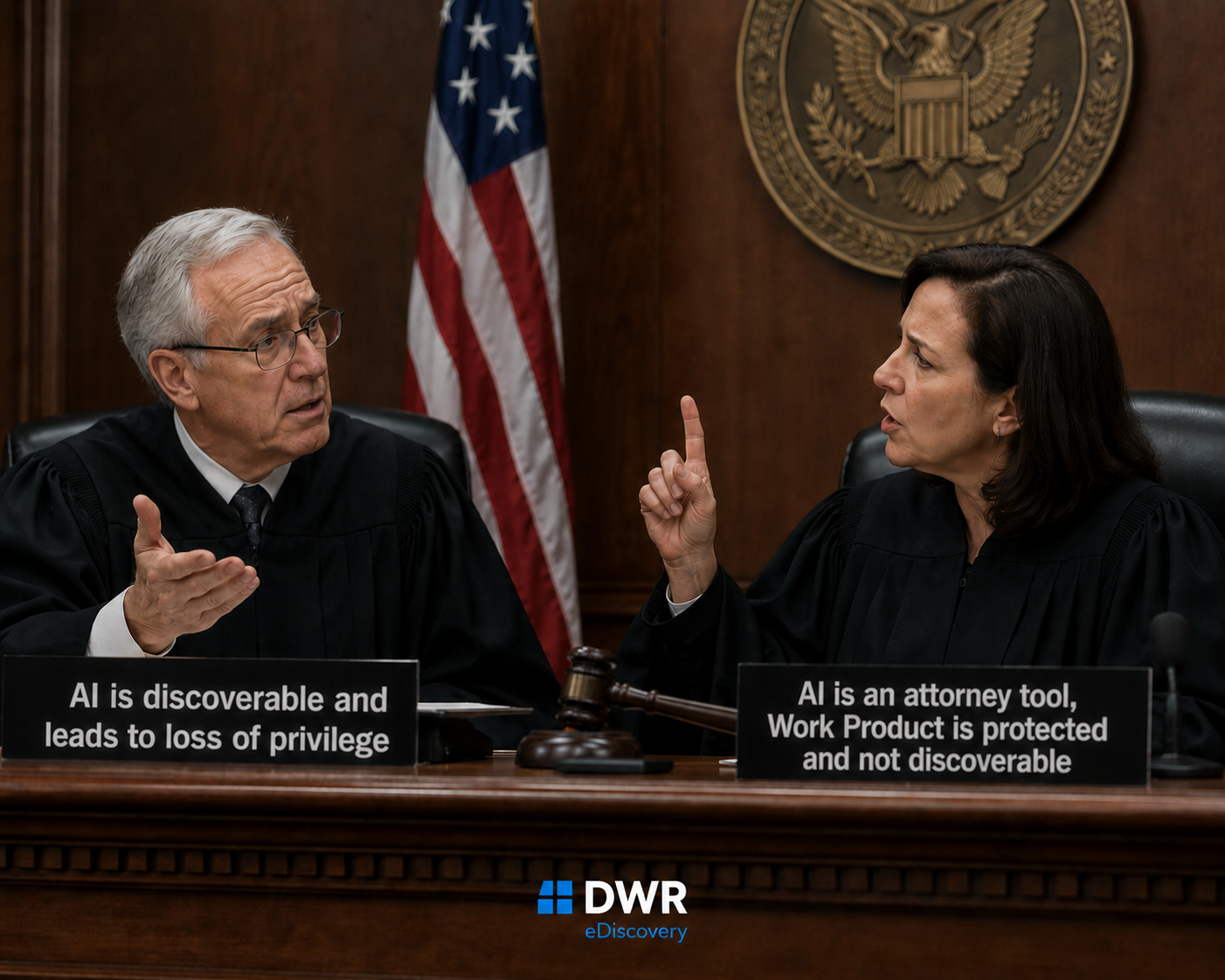
The Heppner/Warner split refers to two federal court decisions issued within days of each other in early 2026 that reached different conclusions about whether materials created using generative AI are protected from discovery. Depending on how you read these two opinions, the actual use of AI to find documents, topics of interest, and summarize documents may not be protected work product.
- Heppner: Using a consumer AI tool independently of your lawyer can destroy privilege and work-product protection.
- Warner: Using AI as a drafting tool does not automatically waive work-product protection.
The split has created uncertainty about how courts will treat AI-assisted legal work.
Considerations for eDiscovery: Digital WarRoom advances AI as an analysis tool that helps to build and deliver defensive Boolean searches to define (1) scope of production, while allowing (2) topic summarization and associated search strings to (iii) organize and assist in fact discovery, not legal strategy
1. United States v. Heppner (S.D.N.Y.)
Facts
A criminal defendant used the consumer version of Anthropic Claude on his own to develop potential defenses and prepare documents, which he later shared with his attorneys.
Holding
The court held that the materials were not protected. The documents and searches are discoverable.
Why?
Judge Rakoff emphasized two factors:
- No attorney involvement.
- The defendant generated the materials without direction from counsel.
- No reasonable expectation of confidentiality.
- Claude's consumer terms allowed use of prompts for training and potential disclosure to third parties, including regulators.
Therefore:
- No attorney-client privilege.
- No work-product protection.
The court essentially treated the AI provider as a third party to whom confidential information had been disclosed.
2. Warner v. Gilbarco, Inc. (E.D. Mich.)
Facts
A pro se plaintiff (representing herself) used ChatGPT to help draft filings in an employment case.
The defendant demanded production of:
- prompts,
- outputs,
- AI activity logs.
Holding
The court refused to compel production.
Why?
Magistrate Judge Patti concluded:
- AI is a tool, not a person.
- Using ChatGPT is more like using Word or Westlaw.
- Work-product waiver requires disclosure to an adversary.
- Merely using AI does not place the information into an opponent's hands.
- Prompts reveal mental impressions.
- Compelling disclosure would expose litigation strategy.
Thus, the plaintiff's AI-assisted drafting remained protected work product.
Summary of the actual "Split"
| Issue | Heppner | Warner |
|---|---|---|
| Type of case | Criminal | Civil |
| User | Represented client | Plaintiff |
| AI used | Consumer Claude | ChatGPT |
| AI viewed as | Third party affecting confidentiality | Tool, not person |
| Work product | Lost | Preserved |
| Result | Discoverable | Protected |
eDiscovery blogs and industry observers argue the cases are factually distinguishable rather than fundamentally inconsistent:
- In Heppner, the problem was a client independently sharing defense theories with a consumer AI platform that lacked confidentiality protections.
- In Warner, the AI interaction itself constituted the litigant's own litigation preparation, and disclosure had not reached an adversary.
As one analysis observed, the courts applied traditional privilege principles to different facts rather than creating entirely new rules for AI.
Practical Takeaways
For lawyers and clients:
- Clients should avoid AI tools for sensitive legal matters unless approved by counsel.
- Avoid indexing and tokenizing documents using LLMs that keep and learn from client documents.
- Document that AI use occurred at the direction of counsel.
- Assume that AI prompts and outputs may someday become discovery disputes.
- Use auditable Boolean search strings, approved by counsel, for final disclosure decisions.
Bottom line
The Heppner/Warner split stands for this emerging principle that can be applied to eDiscovery best practices.
AI itself does not automatically destroy privilege—but who uses it, under whose direction, and under what confidentiality terms may determine whether legal protections survive.
Using the Digital WarRoom eDiscovery AI workflow, documents subject to a document request or disclosure obligation can be quickly identified and affirmatively tagged using defensible Boolean Searches as suggested by AI tools. AI will not make a decision that can be called into question, it will propose document search terms that can used by attorneys to quickly and efficiently tag documents for productions, interrogatories and other disclosure obligations.
Until appellate courts provide clearer guidance, AI-assisted legal work remains a jurisdiction-dependent risk area. The use and disclosure of complex bole an search strings is a minimum-risk, 25 year practice in the courts and throughout case law.





Comment On This Article